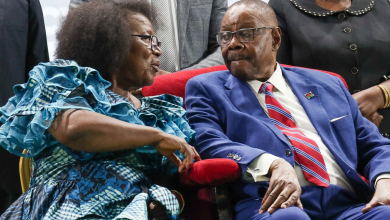
President Peter Mutharika flew to South Africa on a private trip on Wednesday this week. But before he left Kamuzu Palace in Lilongwe, he addressed one of the most politically sensitive questions facing the ruling Democratic Progressive Party (DPP) ahead of the 2030 elections—succession.
He spoke in an interview with State House press secretary Cathy Maulidi amid growing speculation over an alleged rift between him and State First Vice-President Jane Ansah, the woman who shared his presidential ticket just 11 months ago. The pre-trip interview also came in the wake of an increasingly ‘sensitive’ but unavoidable question of who can inherit the leadership of DPP once APM exits the political stage at the end of his constitutional mandate in 2030?
This debate has not only defined national conversations. It has also become the political equivalent of a hot cup of tea for some politicians—too hot to hold, but impossible to ignore. It’s like a delicate game of chess, where some players within the ruling party may be quietly moving pieces behind the board while publicly insisting they are merely watching the political manoeuvring from a distance, perhaps wary of the consequences of being seen too early in the game.
Partly, this is because succession in some of these parties isn’t merely about deciding who can steer the party in the next elections. It also revolves around political loyalty to the ‘bwana’, one’s influence in the party, internal balances of power, underground political networks and the quiet emergence of competing centres of authority.
Back to the interview, for me, the most revealing part wasn’t Mutharika’s rejection of premature succession crusades in the blue ship. It was his expression of hope that, when the time comes, he will hand over power to “another member of the DPP”. Of course, on the surface, the statement sounds like a defence of democracy and party continuity. But we all know that democracy, by its very nature, invites many uncomfortable questions.
Like who exactly qualifies as a “member of the DPP”? Is it one of those familiar men and women sitting comfortably in the party’s NGC? Or someone who will either emerge from outside, or win the confidence of party delegates at the next DPP convention? Better still, could this individual simply receive APM’s personal blessing “when the time is right?”—much like ‘Adzonzi’ in 2019, or the way Peter’s late brother, Bingu, received the endorsement of ex-UDF leader Bakili Muluzi in 2003?
However, before anyone accuses us of creating a storm in a cup of tea, another reasonable question deserves attention: where exactly does the First Vice-President stand in this unfolding conversation, particularly in light of the President’s interview? Yes, it may still be too early to conclude. But I think politics has a curious habit of revealing its answers long before the official statements arrive. Sometimes, the silence, the timing and the positioning tell their own story.
For now, I will leave it there.
Otherwise, we can agree that between 2020 and 2024, Mutharika’s DPP went through political hell largely fuelled by unrestrained ambitions among some of its top-ranking officials who were eager to take over the party leadership. That chapter was marked by factionalism, internal fractures, bitter rivalries and even physical confrontations witnessed by journalists as competing camps jostled for influence and positioned themselves as potential successors to APM.
It is, therefore, unlikely that Mutharika has forgotten those turbulent moments. From Page House in Mangochi, he watched the political drama unfold before his eyes and witnessed the damage those internal battles inflicted on the party’s image. For that reason, his call for political ambitions to wait for the right time is understandable.
Having said that, the biggest test facing the DPP now isn’t whether it can suppress the succession debate within its ranks, but whether it has learnt from its past and can manage the coming transition without re-opening old wounds.
Because, in the end, Mutharika’s greatest legacy will not be the successor he chooses, but the vibrant party he leaves behind—one capable of shaping its future in his absence.